
Going into 2027, an accelerator can be the best decision an early-stage African startup makes, or an expensive detour. The difference is not the brand name. It is your stage, the terms, and whether the programme gives you what you are actually missing.
In this guide
The short answer
Is an accelerator worth it for an early-stage startup in Africa in 2027?
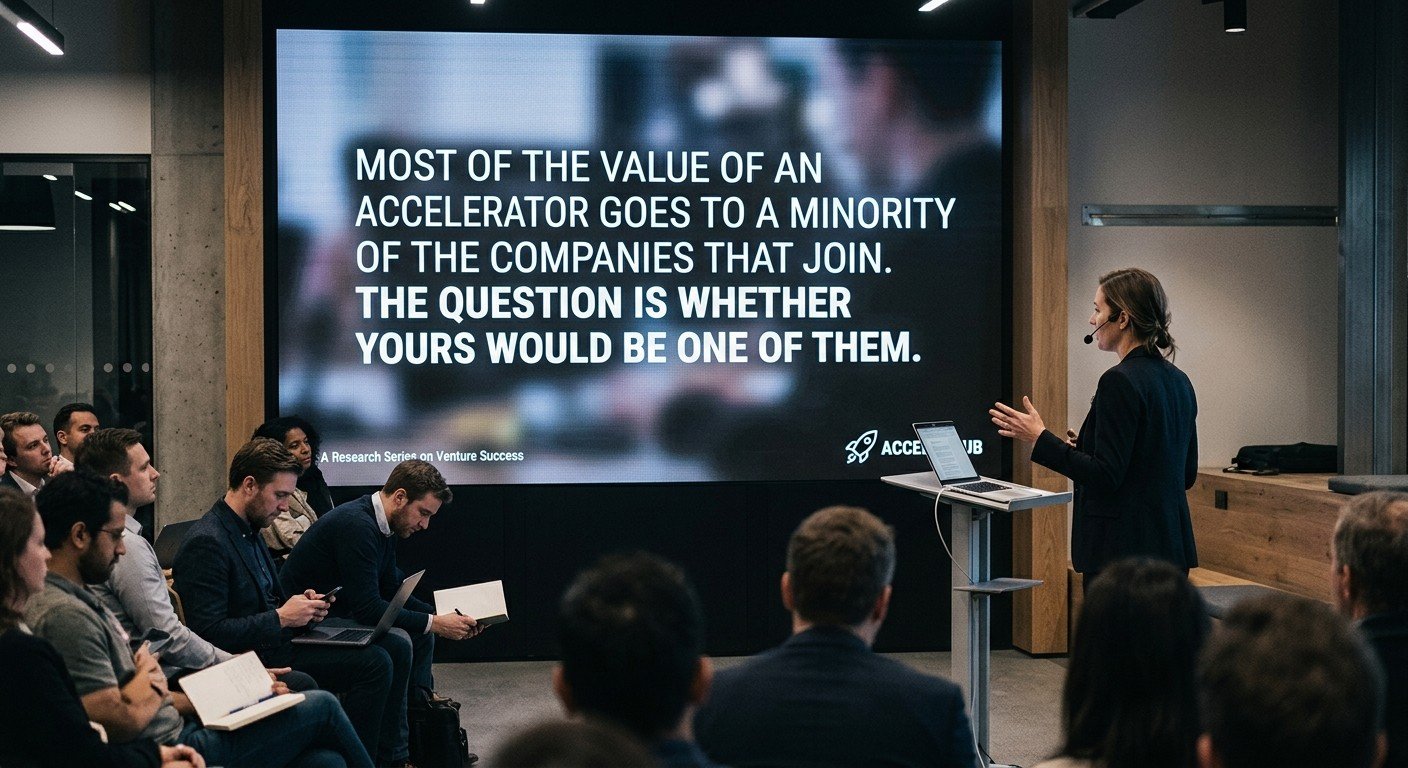
Often yes, but not always. On average, startups that join accelerators grow revenue and raise money faster than similar startups that were rejected. But most of that benefit goes to the strongest quarter of companies, and in Africa the gains show up more in revenue than in investment. An accelerator is worth it when it gives you something you cannot get elsewhere, such as a first institutional cheque, investor introductions or hands-on operating help, on terms that fairly value your company.
- Worth it: you are early, need a first cheque or a network, and the programme’s alumni raise follow-on rounds.
- Not worth it: you already have traction and investor interest, the terms undervalue you, or the programme does not fit your stage or sector.
- Check it is still running: more than half of 74 African accelerators reviewed in 2026 were inactive by 2025.
What the evidence says
The largest study of accelerator outcomes comes from the Global Accelerator Learning Initiative (GALI), run by the Aspen Network of Development Entrepreneurs and Emory University. Its 2021 report tracked 2,599 ventures that applied to 212 accelerator programmes, and compared the 829 that took part with the 1,770 that did not (GALI, A Rocket or a Runway?). Sub-Saharan Africa was the largest region in the sample, with 921 ventures.
Four findings matter most for a founder deciding whether to apply:
- Accelerated ventures do better on average. They outperform rejected applicants on both revenue growth and financing, and the gap widens over time.
- But the median company sees modest growth. A small minority of ventures, the top quarter, capture most of the benefit. Joining does not by itself make a company grow.
- Those who start stronger gain more. Ventures with more financial resources when they apply show greater growth after the programme.
- Where you are matters. GALI found that the investment benefits of acceleration concentrate in high-income countries, while ventures in low- and middle-income countries benefit more through revenue growth (GALI, Does Acceleration Work?).

GALI also asked high-performing founders what made the difference. They pointed to peer networking, strategic introductions, support with the business model and pivots, and the signal that being selected sends to investors. Others said their programme added nothing, because the offer did not match their needs, it focused on investment over business fundamentals, the investor connections were weak, or the cohort never gelled.
Part of the measured benefit comes from selection: accelerators pick ventures that were already likely to grow. That is still useful to you, because being selected is a signal investors read, but it means the programme itself is only part of the story.
The accelerator market: fewer programmes, different deals
The accelerator market in Africa has shrunk sharply. A review of 74 African startup accelerators found that more than half were inactive by 2025, and 70% were headquartered outside Africa (Launch Base Africa). The same analysis found that six major global accelerators (Y Combinator, Flat6Labs, Techstars, Seedstars, Antler and 500 Global) appeared in nine African funding rounds in the first half of 2025 and just one in the first half of 2026. Y Combinator took 24 African startups into its Winter 2022 batch; by 2025 that number had fallen by more than 90%.
Launch Base Africa links the decline to the collapse of donor funding, including the shutdown of USAID’s Prosper Africa, and to global accelerators shifting towards venture capital and venture studios. What is filling the gap: early-stage venture funds, venture studios, grant programmes and development-finance debt. Venture studios in particular have a promising record: a 2026 white paper by FMO, Briter and GIZ SAIS found that about one in two studio-built companies raised follow-on funding, against one in five from traditional incubators (FMO).
Before you apply, check the programme is alive. Our Kenya guide separates programmes active in 2026 from those with no sign of a 2026 programme and those that have closed.
2026 in review and what to expect in 2027
The accelerator decision depends on the funding market around it. Three numbers frame it. African tech raised $4.1 billion in 2025, up 25%, but debt made up 41% of it and seed was the most constrained stage, with $462 million deployed, down 4% (Partech). In the first half of 2026, startups raised about $1.44 billion, level with a year earlier, but across 146 disclosed deals against 252, while debt grew 37% and acquisitions more than doubled to 63 (TechCabal Insights via African Startups).
Six trends to plan for in 2027
These are our view of where the market is heading, based on the 2025 and 2026 data. They are not forecasts from the sources above.
Money is concentrating in fewer companies. Expect the first institutional cheque to stay hard to get, which makes the signal of a good programme more valuable, not less.
Debt reached a record share in 2025 and kept growing in 2026. Revenue-generating startups will have more non-dilutive options; pre-revenue ones will not.
Acquisitions more than doubled in H1 2026. Build for profitability and a clear exit path, because buyers now look for both.
Classic cohort accelerators are retreating; venture studios, early-stage funds, grant programmes and equity-free programmes are filling the gap.
Google’s 2026 Africa class was AI-only, and investors increasingly expect lean, AI-enabled teams. Show how you use AI to do more with less.
Cleantech funding nearly doubled in 2025, and the largest H1 2026 round went to EV company Spiro. Sector specialists here will keep growing.
Dates to plan around
| When | What | Why it matters |
|---|---|---|
| 2 November 2026 | Y Combinator Winter 2027 deadline | Batch runs January to March 2027 in San Francisco |
| 3–4 December 2026 | Latitude59 x Kenya, Nairobi | Investors and a pitch competition for early-stage startups |
| 10–11 February 2027 | Africa Tech Summit Nairobi | Two days of investors, corporates and deal-making |
| Early 2027 | Google for Startups Accelerator: Africa | The 2026 call ran February to March; watch for the next class |
| 10 August 2027 | Kenya general election | Campaign runs 29 May to 7 August; see below |
See the Revise events calendar and our guide on application windows.
Kenya’s August 2027 election and political risk
Kenya votes on 10 August 2027 for the president, parliament and county governments. The electoral commission’s timetable puts party primaries before 9 May, nominations from 29 May to 11 June, and the official campaign from 29 May to 7 August (Khusoko). If results are challenged, uncertainty can run into September or October: in 2017 the Supreme Court annulled the presidential result and a re-run followed on 26 October (The Carter Center).
| Date | Milestone | What to expect |
|---|---|---|
| 9 February 2027 | Public officers who want to run must resign | Political manoeuvring starts in earnest |
| By 9 May 2027 | Party primaries and disputes settled | Rising political noise |
| 29 May – 7 August 2027 | Official campaign period | Investor caution is most likely; rallies and possible disruption |
| 10 August 2027 | Election day | Many businesses slow down around the vote |
| August – October 2027 | Results, possible petitions or re-run | Uncertainty lasts until results are settled |
Timetable as published by the electoral commission, reported by Khusoko.
History cuts both ways. In 2017, the annulment and re-run coincided with growth slowing to 4.9%, the weakest in five years; the World Bank cited drought, weak credit growth and election-related uncertainty that weakened private-sector activity (World Bank). In 2022, by contrast, the election passed peacefully and Kenyan startup funding nearly doubled, from KSh 36.5 billion in 2021 to KSh 71.9 billion (Capital FM, citing Disrupt Africa).
The bigger political risk may come before the campaign. In June 2024, protests against the Finance Bill led the government to withdraw it after parliament was breached, and internet access was disrupted during the protests (Kenya Finance Bill protests). In 2026, cost-of-living pressure and the new Finance Bill have revived fears of renewed protests ahead of the election (The EastAfrican).
How to plan around the election: aim to close a round or join a programme before the campaign starts in late May 2027; build at least nine months of runway from mid-2027; expect slower investor decisions from May to October; keep backup internet, payments and remote-working plans; and if you can, build revenue outside Kenya too. A remote or hybrid programme that ends before the campaign is the safest timing.
What this means for your decision in 2027: with fewer early-stage deals, a strong programme’s signal and investor access are worth more, but only if the programme is still active and its alumni are raising. For Kenyan founders, the first half of 2027, before the campaign, is the best window. Equity is also scarcer, so programmes that take none, or invest on fair terms, deserve a closer look.
What it really costs
An accelerator costs you three things: equity, time and sometimes a fee.
| Deal | Cheque | Equity | Implied post-money valuation |
|---|---|---|---|
| Baobab Network | $100k | 12.5% | $0.8m |
| Antler East Africa (initial) | $100k | 10% | $1.0m |
| Norrsken Impact Accelerator | $125k | 7% | About $1.79m |
| Y Combinator (first $125k) | $125k | 7% | About $1.79m |
| Equity-free programmes (Google, Revise) | Varies | 0% | Not applicable |
Standard deals as published by each programme; see the equity comparison in our Kenya guide.
What would that equity be worth later?
Illustrative only. Enter the equity you would give and a value your company could reach.
Time: most programmes run 8 weeks to 18 months, and some require you to relocate or spend weeks in person. That is time away from customers. Fees: some programmes charge them. 500 Global lists a $35,000 Phase 1 fee for its Nairobi programme, although press coverage describes it as tuition-free, so always ask.

When an accelerator is worth it
- You need your first institutional cheque, and the programme invests or reliably gets its alumni funded.
- You lack the network: no investors, mentors or corporate partners who will take your call.
- You are early and need structure: help to find customers, set pricing and build the business model.
- The alumni record is real: a good share of past cohorts raised follow-on rounds within 12 to 18 months.
- It is a sector specialist in your field, with pilot partners and investors who understand it.
- The terms are fair compared with what an angel would offer you for the same stake.
When it is not
- You already have traction and investor interest. Raising directly may cost less equity.
- The programme does not fit your stage, sector or location, so you would spend months on things you do not need.
- Relocation would stall your sales or pull founders away from the market you are building in.
- The business only works on grants. Several Kenyan programmes stopped when donor funding was cut.
- The programme has gone quiet. Check for a current call and recent cohorts first; see our status section.
- The equity is too cheap. A valuation well below what an angel would offer is a poor trade unless the support is exceptional.
Your scorecard: is this programme worth it for you?
Think of one specific programme, then tick what is true.
Programme fit
Your answers stay in your browser.
Alternatives to an accelerator
| Option | Best when | What it costs |
|---|---|---|
| Angel investors and syndicates | You have early traction and a clear story | Equity, often at a better valuation than accelerators |
| Grants and competitions | Your business has measurable impact | Time on applications and reporting; no equity |
| Venture studios | You have domain knowledge but no team | A large equity share, sometimes the majority |
| Equity-free programmes | You need expertise, structure and introductions more than cash | Time, sometimes a fee; no equity |
| Customer revenue | Customers will pay or prepay | Nothing, and it is the strongest signal to investors |
| A co-founder first | You are solo and missing key skills | Equity shared with a partner; makes every application stronger |

For the full picture of funding options, read how to raise startup funding in East Africa.
Where the Revise Accelerator fits
Revise is an AI-native, equity-free accelerator for founders across Africa, so it answers some of the trade-offs above differently. To be transparent about the terms:
Equity
Not now, not later.
USD programme fee
Paid only once you are accepted, upfront or as four monthly payments of 300 USD. Applying is free.
Success fee
Only on capital raised through our network or grants we helped you win.
USD co-investment eligibility
From Revise Angels alongside your lead investor, subject to our investment committee. Not guaranteed.
It is a good fit if you want four months of hands-on work with a named operator, two on go-to-market and two on funding, without giving up equity. It is not the right choice if what you need most is a cash cheque now: Revise does not invest by default, so a programme like Antler, Baobab or Madica may suit you better.
Decide with real information
Applying is free and takes about five minutes. A person reads every application.
Frequently asked questions
Is an accelerator worth it for an early-stage startup in Africa?
Often, but not always. Accelerated startups grow revenue and raise money faster on average than rejected applicants, but most of the benefit goes to the strongest quarter of companies, and in Africa the gains show up more in revenue than investment. It is worth it when the programme gives you a first cheque, investor access or operating help you cannot get elsewhere, on fair terms.
How much equity do accelerators take in Africa?
Typically 7% to 12.5% for $100,000 to $125,000. Baobab takes 12.5% for $100,000, Antler 10% for $100,000 plus a follow-on, and Y Combinator 7% for its first $125,000. Equity-free programmes such as Google for Startups Accelerator: Africa and the Revise Accelerator take none.
Do accelerators guarantee funding?
No. Some invest a fixed amount when you join, but none can guarantee that you will raise a follow-on round. Be wary of any programme that promises investment.
Are equity-free accelerators worth it?
They can be, if you need expertise, structure and introductions more than cash. Check what support you actually get, whether there is a fee, and what happened to past cohorts.
What are the alternatives to an accelerator?
Angel investors, grants and competitions, venture studios, equity-free programmes, customer revenue, and finding a co-founder first. The right choice depends on your stage and what you are missing.
Will it be harder to get into an accelerator in 2027?
Probably. There are fewer active programmes than a few years ago, and early-stage funding is concentrating in fewer companies: African startups closed 146 disclosed deals in the first half of 2026, against 252 a year earlier. Strong applications with real traction will stand out more.
Will Kenya’s 2027 election affect startup funding?
It can slow decisions. Kenya votes on 10 August 2027, with the campaign from 29 May to 7 August. In 2017 an annulled result and re-run coincided with weaker growth, while in 2022 startup funding nearly doubled despite the election. Plan to raise or join a programme before the campaign, and keep extra runway into late 2027.
How do I know if an accelerator is still active?
Look for an open call or a cohort announced in the last year, and recent investments. More than half of 74 African accelerators reviewed in 2026 were inactive by 2025, so do not rely on older lists.
Keep reading
Sources
All pages accessed in October 2026.
- GALI: A Rocket or a Runway? Examining venture growth during and after acceleration (2021)
- GALI: Does Acceleration Work? (2021)
- GALI: Acceleration in Sub-Saharan Africa (2018)
- Launch Base Africa: Is this the end of the accelerator era in African tech? (July 2026)
- FMO, Briter and GIZ SAIS: Venture Studios in Africa
- Partech: 2025 Africa Tech Venture Capital report
- African Startups: H1 2026 funding (TechCabal Insights data)
- Y Combinator: Apply
- Khusoko: IEBC sets 10 August 2027 as election date
- World Bank: Kenya’s GDP growth slumps in 2017 (December 2017)
- The Carter Center: final report on Kenya’s 2017 elections
- Capital FM: Kenyan startups raise a record KSh 71.85bn in 2022
- Kenya Finance Bill protests (overview)
- The EastAfrican: Gen Z protests return to haunt Ruto’s government
- Google for Startups Accelerator: Africa
- The Baobab Network FAQ
- Antler Kenya
- Y Combinator: the $500,000 standard deal
- 500 Global: Sustainable Innovation Seed Accelerator Nairobi